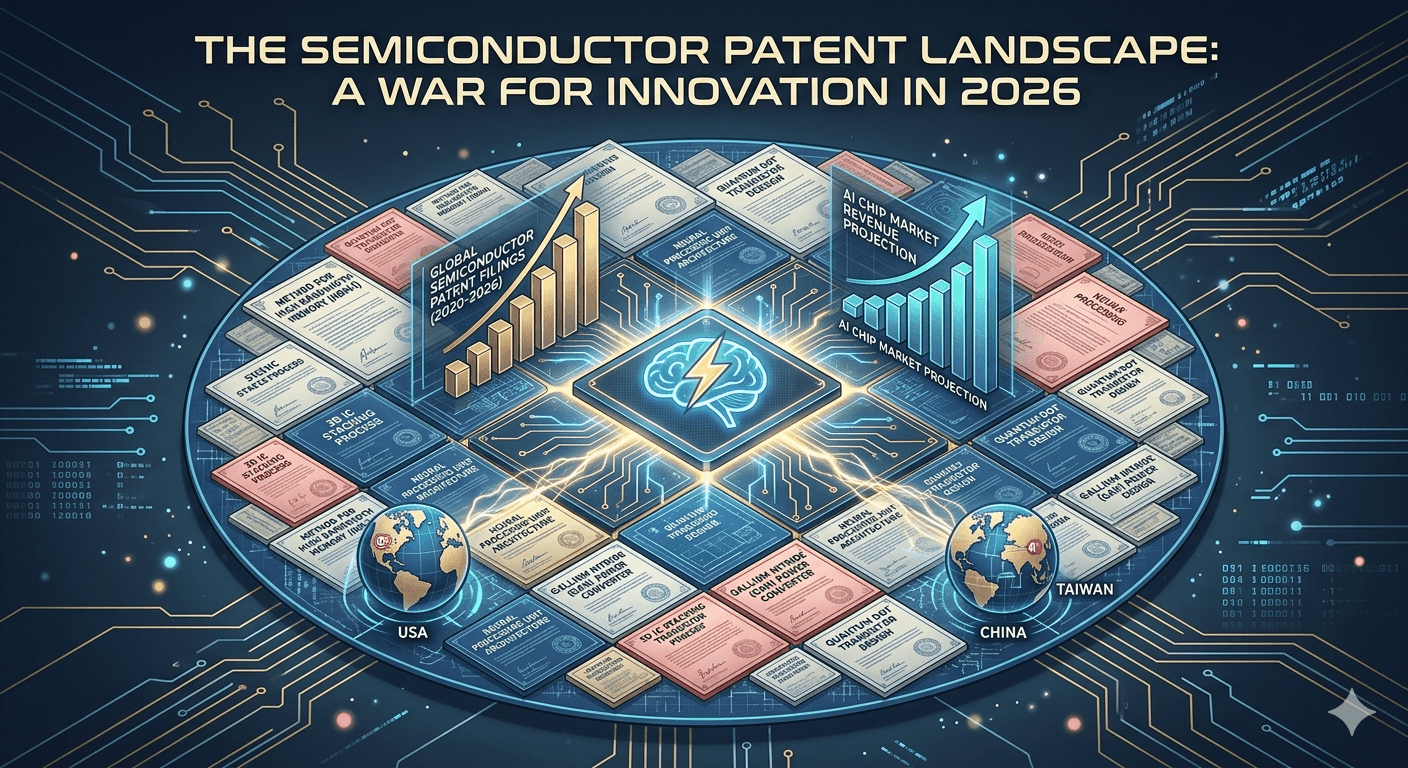
In the fast-moving world of semiconductors, innovation is the only currency. But as we move into 2026, it is not just about who builds the smallest transistor—it is about who owns the rights to it. With the global semiconductor market projected to reach $975 billion in annual sales by 2026, patents have evolved from mere legal protections into strategic national security assets.
Here is how the patent landscape is reshaping the future of chips.
1. AI: The Massive Patent Engine
Artificial Intelligence is driving a historic revenue boom, with generative AI chips expected to account for roughly half of all chip sales by 2026. This gold rush has triggered a surge in patent filings for specialized hardware:
- Custom Silicon & Accelerators: Companies like NVIDIA (holding over 1,300 AI hardware patents), Intel, and AMD are aggressively patenting GPU improvements and neural network processing.
- Memory Breakthroughs: High Bandwidth Memory (HBM) is the "scarce currency" of AI. Patents for HBM3E, HBM4, and 3D NAND flash are currently the most contested territories as data transfer speeds become the ultimate bottleneck.
2. The Geopolitical Patent Battleground
Patents are no longer just corporate trophies; they are "national security anchors".
- Regional Dominance: The U.S. currently leads in design tool IP, while Asia dominates manufacturing patents. China has made "semiconductor sovereignty" a core goal, now filing more than half of the world's chip patent applications.
- Strategic Reshoring: Countries are using IP dominance to secure domestic supply chains. For example, the India Semiconductor Mission 2.0 (launched in February 2026) emphasizes creating a "full-stack Indian semiconductor IP" to reduce dependency on foreign giants like TSMC.
3. Emerging "White Spaces" for Innovation
As traditional transistor scaling (moving toward 2nm and "Angstrom-class" nodes) becomes increasingly difficult, new patentable frontiers are opening up:
- Advanced Packaging: Techniques like 3D IC stacking and hybrid bonding are seeing a massive influx of IP as they allow for better performance without shrinking the silicon further.
- Wide-Bandgap Materials: Silicon Carbide (SiC) and Gallium Nitride (GaN) are becoming the backbone of power architectures for EVs and AI data centers, with patent filings in these areas growing at a CAGR of roughly 20%.
4. High-Stakes Litigation
With so much at stake, patent wars are becoming more frequent and global.
- Recent Settlements: In February 2025, Samsung settled a major dispute with Harvard University regarding vapor deposition methods (CVD/ALD) crucial for thin-film manufacturing.
- The Rise of Indirect Infringement: Courts are becoming stricter. In early 2024, a landmark South Korean ruling awarded damages for "indirect infringement," holding companies liable for selling components that lead to the use of a patented invention.
The Bottom Line
In 2026, a robust patent portfolio is more than a legal shield—it is a competitive weapon that attracts investment, enables lucrative cross-licensing, and safeguards multi-billion dollar R&D budgets. For any firm in the semiconductor space, from startups to giants like Marvell Technology (which holds over 10,000 patents), the message is clear: Innovate, but protect it first.